How Older Homes Are Revealing New Vulnerabilities to Water Intrusion
Why Older Foundations Are Struggling With Modern Rainfall Patterns
Home construction standards from several decades ago were built around rainfall patterns and drainage expectations that no longer match what many regions experience today. Foundations poured in the 1960s through the 1990s were often designed with minimal waterproofing membranes, relying instead on soil composition and gravity to keep moisture away from the structure. As storm intensity has increased in many parts of the country, those older assumptions have started to fail in visible ways. Homeowners who never had water problems for twenty years are suddenly facing damp carpets or standing water after a single heavy storm.
This shift has changed how homeowners think about their basements, moving the conversation from occasional nuisance to a recurring maintenance concern. Real estate agents now mention drainage history during showings, and inspectors spend more time examining grading and sump pump function than they did a generation ago. Insurance adjusters report a steady rise in water damage claims tied to basement flooding, particularly in neighborhoods built before modern stormwater codes were adopted. The result is a growing awareness that foundations are not static barriers but systems that interact with soil, groundwater, and rainfall in ways that shift over time.
What Inspection Data Reveals About Common Entry Points
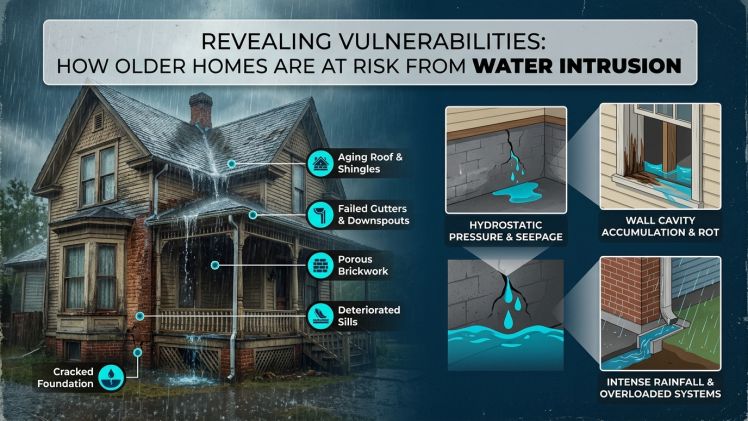
Restoration professionals who respond to flooded basements consistently point to a handful of recurring failure points rather than a single dramatic cause. Hairline cracks in foundation walls, gaps around utility penetrations, and deteriorated window well seals show up again and again in service reports. Grading problems, where soil slopes toward the house instead of away from it, are cited almost as often as structural cracking. These patterns suggest that flooding is rarely the result of one catastrophic failure and more often the product of several small vulnerabilities compounding during a heavy rain event.
Field technicians also note that sump pump failures are a leading contributor, often tied to power outages during the same storms that create the water problem in the first place. A pump without battery backup can perform perfectly for years and then fail at the exact moment it is needed most. Drain tile systems that were installed correctly decades ago can clog with sediment over time, reducing their capacity without any visible warning sign on the surface. When technicians document these recurring issues, they are effectively building a map of where attention should be focused before the next storm arrives.
Matching Your Basement’s Weak Points to the Right Fix
Homeowners trying to figure out their own risk factors can start by walking the perimeter of the house after a rainstorm and noting where water pools or flows toward the foundation. A detailed explanation of why basements flood can help translate these observations into a clearer picture of what is actually happening below grade, since surface clues often point directly to subsurface problems like saturated soil or failing drain tile. Comparing those observations against the specific entry points mentioned earlier gives a homeowner a reasonable starting list of priorities rather than a vague sense that something should be done eventually.
Once a problem area is identified, the repair approach should match the scale of the issue rather than defaulting to the most expensive option available. A small crack with minor seepage may only need an interior sealant system, while chronic flooding from poor grading calls for exterior regrading or a French drain installation. Professionals who follow IICRC restoration standards during assessment and remediation tend to document moisture levels and structural conditions more thoroughly, which gives homeowners a clearer basis for deciding between a quick fix and a more substantial repair. That documentation also matters if the issue later becomes part of an insurance claim.
Routine maintenance remains the most overlooked part of basement protection, even among homeowners who have already invested in waterproofing systems. Gutters need clearing twice a year, sump pump batteries need testing before storm season, and foundation cracks need periodic inspection even when they appear stable. None of these tasks are expensive or time consuming on their own, but skipping them for several seasons in a row tends to be exactly when a minor vulnerability turns into a genuine flooding event. Treating the basement as a system that needs periodic attention, rather than a finished space to be forgotten, is what separates homes that stay dry through heavy storms from those that end up calling a restoration company.