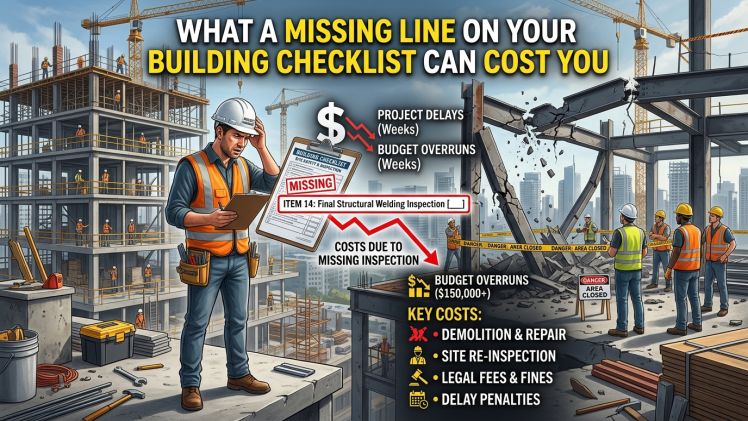
What a Missing Line on Your Building Checklist Can Cost You
Mapping Out Your Pre-Construction Decisions
Skip a step in the early planning phase and the consequences rarely show up right away. They surface months later as a permit delay, a budget overrun, or a foundation poured in the wrong spot relative to setback lines. A building checklist exists to catch these problems before concrete, lumber, or money gets committed, and the strongest ones are built around decisions rather than tasks. Lot evaluation, soil testing, utility hookups, zoning confirmation, and financing structure all belong in this category because each one shapes everything that follows.
Homeowners often treat checklists as a single document, but in practice there are at least three distinct versions worth keeping separate. There’s the pre-purchase checklist that covers land and feasibility, the design-phase checklist that tracks architectural decisions and material selections, and the construction-phase checklist that monitors inspections, timelines, and contractor accountability. Mixing these together creates confusion about what needs attention at a given moment. Separating them lets you focus on the right questions during the right window, which matters most when multiple decisions are competing for your attention at once.
Comparing Builder Qualifications Against Site-Specific Demands
Not every builder is equipped to handle mountain terrain, extreme weather swings, or the permitting quirks that come with high-elevation construction. A Park City custom home builder has to account for frost depth, snow load requirements, and access limitations that a flatland crew might never encounter. Evaluating builders against these site-specific demands means asking for examples of comparable projects, not just a general portfolio. A builder who has handled similar elevation, soil composition, or seasonal access restrictions will anticipate problems that a less experienced crew might discover the hard way.
Licensing and insurance checks are the baseline, but they tell you almost nothing about how a builder handles the unexpected. Ask how they’ve managed delayed material shipments, how they communicate schedule changes, and how they document change orders. A builder willing to walk through a past project in detail, including what went wrong, is usually more trustworthy than one who only offers polished outcomes. Request references from homeowners whose projects wrapped up at least a year ago, since early reviews tend to be more generous than ones written after living in a finished house through a full season.
Price comparisons matter, but they’re only useful once you know what’s included in each bid. Two quotes that look similar on paper can represent very different scopes of work, materials, and contingency planning. Ask each builder to itemize allowances for finishes, site prep, and unforeseen conditions so you’re comparing equivalent packages rather than guessing at what’s been left out.
Weighing Timeline Flexibility Against Budget Certainty
Every building project eventually forces a trade-off between staying on schedule and staying within budget, and rarely can you optimize both at once. Choosing a fixed timeline often means accepting premium costs for expedited materials or overtime labor. Choosing strict budget discipline usually means accepting that weather delays, permitting backlogs, or supply chain issues will push your move-in date further out. Before signing a contract, decide which of these two pressures you can tolerate better, because that decision will shape how you respond when problems inevitably arise mid-project.
Safety planning deserves a place in this conversation too, since shortcuts taken to protect a timeline often introduce risk that shows up later as rework or liability. Reviewing OSHA construction safety resources before construction begins gives homeowners a clearer sense of what proper jobsite protocols look like, which makes it easier to ask informed questions if something on-site seems off. A builder who treats safety standards as a formality rather than a priority is often cutting corners elsewhere too.
Once you’ve weighed these trade-offs, put the decision in writing as part of your contract rather than leaving it as a verbal understanding. Specify how delays will be communicated, what triggers a change order, and what happens if a material substitution becomes necessary. This protects both parties and removes ambiguity at the exact moments when tension tends to run highest. A written framework also gives you something concrete to reference if a dispute arises later, rather than relying on memory or assumptions about what was originally agreed upon.