
Why Holiday Lighting in Salt Lake City Homes Often Falls Short
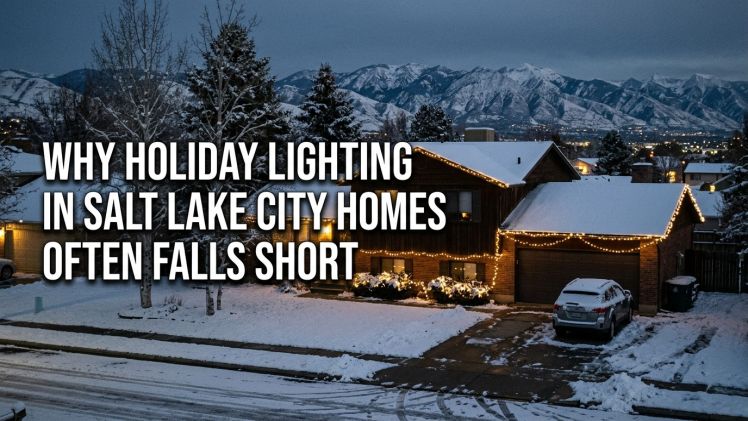
Tangled Strands and Blown Fuses: The Yearly Setback
Most homeowners assume that holiday lighting is simply a matter of pulling a few boxes out of the garage, untangling last year’s strands, and hoping for the best. That assumption works fine until the first cold snap hits and half the lights on a string refuse to turn on, or a breaker trips the moment the display is plugged in. The truth is that the Wasatch Front’s climate, with its freeze-thaw cycles and heavy snow loads, puts real stress on consumer-grade lighting products that were never designed for repeated outdoor installation and removal.
Every autumn, local hardware stores see a rush of customers replacing strands that failed after a single season, often because the wiring degraded from UV exposure or the connectors corroded from moisture. Ladders, icy roof-lines, and gutter clips add physical risk on top of the electrical headaches. What looks like a simple seasonal chore turns into an annual gamble involving time, money, and occasionally a trip to urgent care. Recognizing that the traditional approach to holiday lighting has real limitations is the first step toward finding something that actually holds up.
Many homeowners only notice how worn their equipment has become once the display is already half-finished, with a dead section discovered after the ladder is already put away for the night. That discovery often leads to a late-night run to a crowded store for replacement bulbs or fuses, a scenario that repeats itself across neighborhoods throughout the valley every December. Over several seasons, the cumulative cost of replacement strands, extension cords, and clips can rival the price of a more permanent solution, even before factoring in the hours spent untangling and rehanging lights each year.
Rethinking Installation as an Investment Rather Than a Chore
A growing number of homeowners in the valley are shifting away from the box-in-the-garage model and toward permanent, professionally installed lighting systems built into the roof-line itself. These systems use commercial-grade fixtures rated for year-round outdoor exposure, which means they are not pulled down and restrung every winter. The wiring is concealed, the connections are weatherproofed, and the whole system is engineered to survive snow, wind, and temperature swings without the annual replacement cycle that plagues retail light strings.
For residents looking into Christmas lights in Salt Lake City, Christmas lights in Salt Lake City installation services have become a practical answer to a problem that used to feel unavoidable. Instead of a seasonal scramble, the system stays in place, controlled through an app that lets homeowners switch colors or schedules for different holidays and occasions throughout the year. That flexibility turns a once-a-year hassle into something closer to a standing feature of the house, similar to landscape lighting or an irrigation system.
The upfront cost is higher than a bag of string lights from a big-box store, but the math changes when you factor in the labor, the ladder risk, and the repeated purchases of replacement strands. Professional installers also typically offer warranties and maintenance checks, which removes the guesswork of diagnosing a dead section mid-December. For a lot of households, the appeal isn’t just convenience, it’s the elimination of a recurring annual problem that used to show up like clockwork every winter.
Questions Worth Asking Before You Commit to a System
Not every lighting company offers the same quality of fixture or the same level of service, so it pays to ask specific questions before signing a contract. Find out whether the fixtures are rated for permanent outdoor use or are simply heavier-duty versions of seasonal lights, since that distinction affects how long the system will last through Utah winters. Ask about the warranty terms, who handles repairs if a section fails, and whether the installer provides support during the first storm of the season when demand for service calls spikes.
Energy use is another factor worth weighing, particularly if the display will run for several hours a night across multiple months. LED fixtures draw a fraction of the power that older incandescent strands require, and checking a product against ENERGY STAR lighting guidance can help homeowners compare efficiency ratings before choosing a system. Lower energy draw also means less strain on home electrical circuits, which matters when a display covers an entire roof-line rather than a single string around a doorway.
It also helps to ask how the installation interacts with the home’s existing roof-line, gutters, and siding, since a poorly mounted system can cause more damage than the lights it replaces. A reputable installer will walk through mounting points, explain how the wiring is secured, and describe how the system holds up against the specific weather patterns of the region. Asking for references from other homeowners in the same climate zone can also reveal how a system performs after several winters rather than just on installation day. Taking the time to ask these questions before committing tends to save homeowners from the same frustrations that pushed them away from retail lighting in the first place.